Description:
Background
Thermoresponsive hydrogels are attractive for injectable wound closure and other in situ forming applications because they can be applied as free-flowing liquids at low temperature and then gel near physiological temperatures. Their practical use, however, is limited by slow or incomplete gel-to-sol recovery after exposure to elevated storage temperatures, especially for higher molecular weight and higher concentration formulations.
Technology Description
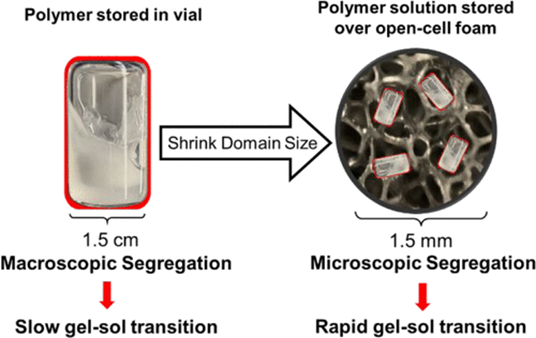
USC researchers have developed a hydrogel that improves the reversibility of thermoresponsive sealants by loading the hydrogel into a high surface area open-cell foam host. The approach reduces domain size and accelerates solvation during cooling. The strongest performance was observed with medical-grade polyurethane foam, which produced nearly quantitative recovery and about a 10-fold improvement in recovery relative to hydrogel stored without foam. Importantly, the method improves recoverability without degrading the core material properties.
Benefits
•10x improved recovery relative to hydrogels without foam
•Reliable redispersion after thermal stress
•Reduced irreversible phase separation during storage
•Low-cost and compatible with syringe-based delivery
•Applicable to systems that require thermal robustness without sacrificing function
Stage of Development
lab prototype
Applications
•Injectable would sealants
•Agriculture and food-industry gel systems
Publications