Description:
Background
The use of liquid organic hydrogen carriers (LOHCs) for hydrogen storage and transport offers higher volumetric hydrogen densities than compressed gas and utilizes existing liquid fuel infrastructure. Previous attempts of ethanol dehydrogenation give only one equivalent of H2 and form undesirable side reactions.
Technology Description
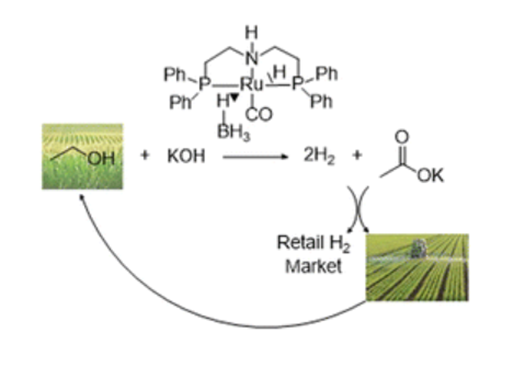
This technology establishes ethanol as a one-way LOHC capable of releasing two equivalents of H2 per molecule via direct catalytic dehydrogenation to potassium acetate. This pathway is designed to favoring selective carboxylate formation coupled with hydrogen evolution. Integrating ethanol dehydrogenation with potassium salt formation achieves a higher overall hydrogen yield than prior ethanol-based LOHC approaches while eliminating the need for carrier recycling.
Benefits
•2x increased effective hydrogen yield
•High-value potassium acetate byproduct
•Elimination of carrier regeneration and associated transport and infrastructure
•Scalable operation with reduced reliance on precious metal catalysts and petrochemical intermediates
Stage of Development
•Lab prototype
•Patent status: pending
Applications
Distributed hydrogen production and storage
Agricultural fertilizer manufacturing
Renewable fuel and chemical integration platforms
Publication
Sustainable Energy Fuels, 2025, 9, 942-946. DOI: 10.1039/d4se01524j