Description:
Market Opportunity
There is growing interest in 2D materials, such as graphene and few-layer transition metal dichalcogenides (TMDCs), due to their unique properties, including linear band dispersion and high carrier mobility. TMDCs, like MoS2, WS2, and WSe2, offer finite bandgaps in the visible range and exhibit varying optical properties with layer thickness, making them candidates for optoelectronic devices. Monolayer TMDCs in particular have garnered attention due to their direct bandgap nature. Overcoming their limited optical densities holds potential for practical device utilization in various industries.
USC Solution
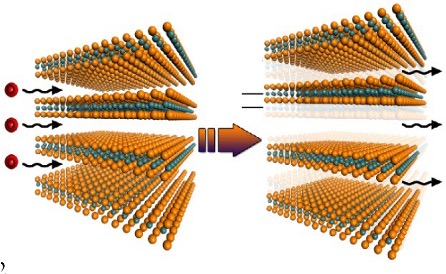
USC researchers have developed a method to enhance the optoelectronic properties of many-layer MoS2 using low-energy oxygen plasma treatment. The treatment significantly increases photoluminescence (PL) without reducing layer thickness. This transition from an indirect to direct bandgap material is achieved by increasing interlayer separation. The method is scalable and robust, demonstrated by enhanced PL signals in the majority of tested MoS2 flakes. This approach overcomes the limited optical density of monolayer MoS2 while maintaining thickness.
Value Proposition
- Enhanced optoelectronic properties
- Significant increase in photoluminescence
- Transition from indirect to direct bandgap material
- Scalable and robust method
Applications
- Optoelectronics
- Fabrication of cross plane p-n junctions
Publications
Direct Bandgap Transition in Many-Layer MoS2 by Plasma-Induced Layer Decoupling, Dhall et al., 2015.
Stage of Development
- Method detailed for developing material with the direct bandgap of monolayer MoS2
- Available for exclusive and non-exclusive license