Description:
Market Opportunity
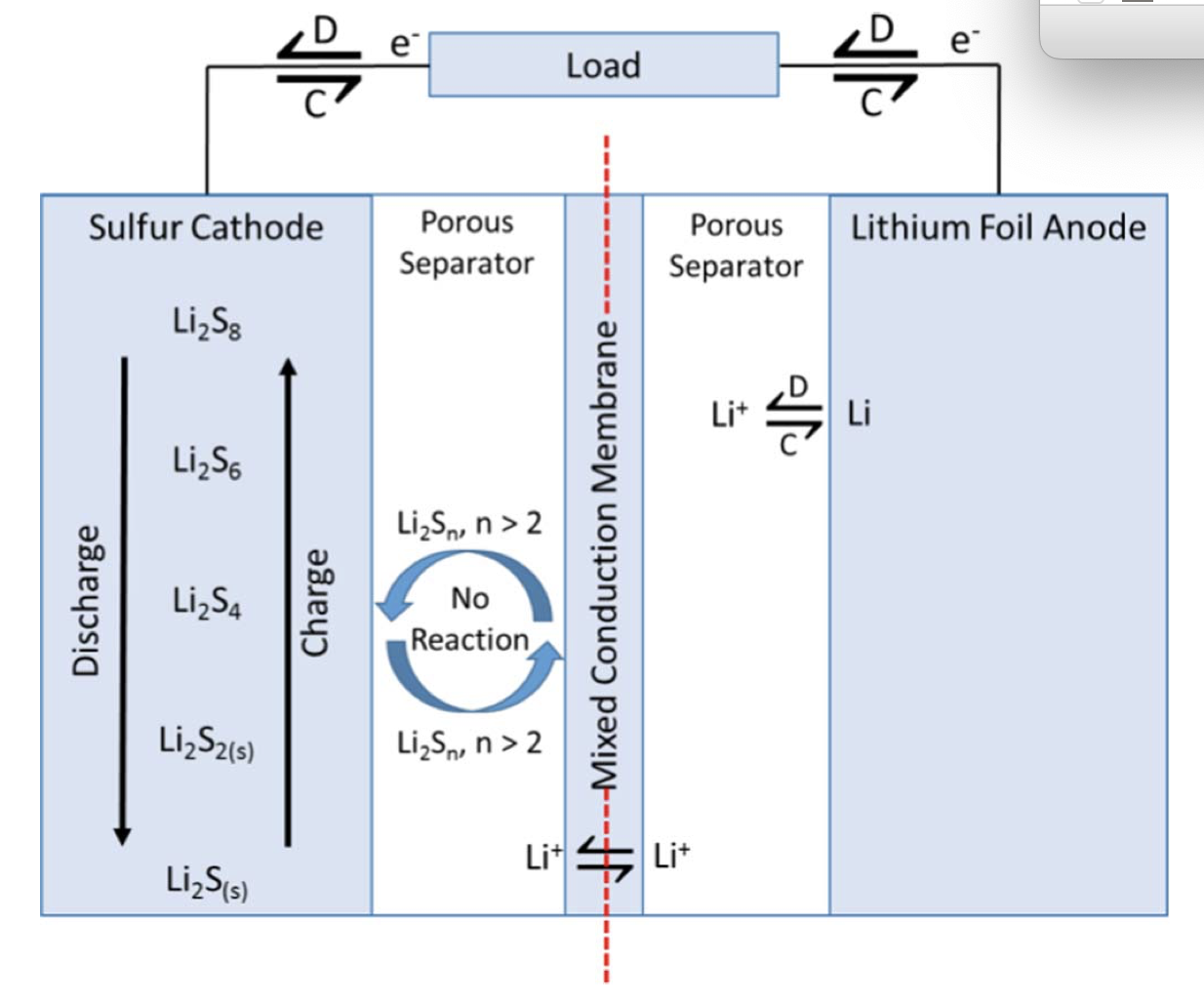
The rechargeable lithium-sulfur (LiS) battery is of considerable interest due to its high theoretical specific capacity and energy density. However, the large-scale deployment of lithium-sulfur batteries has been limited by several performance issues relating to power density and cycle life. The major technical issue impairing the cycle life of the lithium-sulfur battery is the shuttling of polysulfide ions between electrodes.
USC Solution
USC researchers have designed a unique, thin, free-standing, non-porous lithium-ion mixed conductor membrane (LCO) that prevents the irreversible precipitation of polysulfide species at the anode. It is capable of conducting lithium ions necessary for charge and discharge processes.
Value Proposition
- Unique lithium-ion mixed conductor membrane designed to improve life cycle of LiS batteries
- LiS cell with the LCO membrane retained 83% of its initial capacity after 200 cycles in comparison to 18% retention by LiS without an LCO membrane
- Shuttle currents of LiS cell with LCO membrane lower than those of the LiS cell with no membrane
Stage of Development
- Available for exclusive and non-exclusive license
Applications
- Development and optimization of lithium sulfur batteries for commercial use
- Electric vehicles
Publications
https://doi.org/10.1149/2.0181704jes