Description:
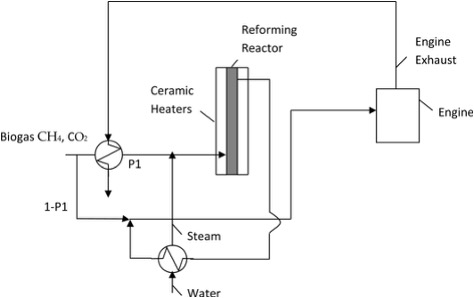
- Production of engineered biogas
Market Opportunity
Nitrogen oxides (NOX) are major components of pollution and contribute to the production of ozone. Lean, premixed fuel-gas combustion is gaining attention as a method for reducing NOX emissions. Adding hydrogen (H2) to biogas mixtures further enhances combustion stability and decreases NOX emissions. However, producing hydrogen in situ in an economically efficient manner during power generation remains a challenge.
USC Solution
USC researchers have developed a system for efficiently reforming biogas with H2. A waste energy chemical recuperation process was successfully implemented to reform biomethane from landfill gas using waste heat from a gas engine. The reforming reaction improved combustion stability and reduced NOX emissions when blended with raw biogas and burned in an internal combustion engine. Testing showed enhanced engine performance and reduced NOX emissions compared to burning raw biogas alone. This work confirms the technical and economic feasibility of utilizing reforming products in biogas combustion, making it a valuable advancement in the field of biogas utilization.
Value Proposition
- Improved combustion stability and reduced NOX emissions
- Enhanced engine performance compared to burning raw biogas alone
- Demonstrated technical and economic feasibility of utilizing reforming products in biogas combustion
Stage of Development
Experimentally validated on site.
Publications
https://doi.org/10.1021/acs.iecr.6b0 4290