Description:
Market Opportunity
Additive manufacturing continues to find applications in rapid prototyping and manufacturing. One popular technique, stereolithography, uses light energy to trigger a polymerization reaction that solidifies select portions of a photo-curable resin. Advances have been made in speed, resolution, and size. To fabricate large parts, elaborate systems use a mask image projection to cure large areas at once. However, they are limited by the number of pixels in a digital projection, resulting in lower resolution and the inability to fabricate fine details. Seeking high resolution for large parts, researchers have used high refresh rate projectors that synchronize the movement of the projector with the curing of the printed part. The high refresh rate requirements are a challenge for current projectors.
USC Solution
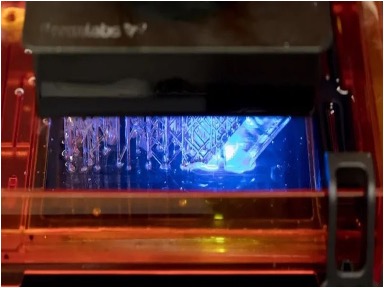
USC researchers have developed a high resolution stereolithography (SL) process that uses a novel motion blur correction method to achieve continuously moving projection light over a large building area. The hopping light SL system combines a XY linear stage and a rotating mirror so that the projection system can be moved continuously without stop-and-go, while the projection image can stay at a fixed position for a certain time for photocuring and hop to the next position when needed. By using such a continuously moving light method, the hopping light SL process can eliminate the extra time for translating the projection system using the stop-and- go method while keeping a relatively low image refreshing rate (less than 120Hz).
Value Proposition
- High resolution over large print area
- Low refresh rate, low-cost projection system
- Low computational requirements
Applications
- Additive manufacturing
- SLA
- Laser sintering/melting
Publications
Hopping Light Vat Photopolymerization for Multiscale Fabrication, Xu et al., 2022.
Stage of Development
- Available for exclusive license