Description:
Market Opportunity
Vat photopolymerization offers benefits over soft lithography for microfluidic device production, but the technique struggles with controlled micrometer- sized channels due to transparent resin's deep light penetration. This results in over-curing and channel blockages. There is a potential market opportunity for the development of more precise and efficient vat photopolymerization techniques or alternative microfluidic fabrication methods.
USC Solution
USC researchers present a novel 3D printing process, called in situ transfer vat photopolymerization, to solve the over-curing issue encountered in microfluidic device production. The method produces high- accuracy microchannels with sub-10µm Z-resolution and does not require liquid resins with reduced transparency or fabrication speed. Unlike other specialized vat photopolymerization techniques, the approach is universally applicable and compatible with 405 nm light sources and commercial photocurable resins.
Value Proposition
- Enables creation of small-gap, high-accuracy microfluidic devices
- Produces high-accuracy microchannels
- No requirement for reduced transparency or speed
- Works with commercial photocurable resigns
Applications
- Biotechnology
- Nanofluidics
- Microelectronics
Publications
In-situ transfer vat photopolymerization for transparent microfluidic device fabrication, Xu et al., 2022.
Stage of Development
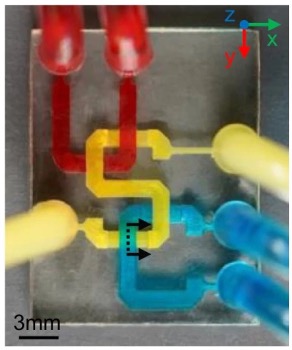
- Validated with multifunctional devices, including 3D serpentine microfluidic channels, valves, and particle sorters
- Available for licensing