Description:
Background
To unlock the commercial potential of quantum computing, companies must overcome the critical hardware bottlenecks of decoherence and crosstalk which currently limit the reliability of complex algorithms. Decoherence represents a rapid "leakage" of data caused by environmental interference, while crosstalk acts as digital noise that corrupts calculations when multiple qubits are operated simultaneously. For industries like pharmaceuticals, finance, and logistics, these errors translate into inaccurate results and wasted computational resources. Developing efficient, scalable methods to suppress these errors is necessary to transition from prototypes to "production-ready" systems.
USC Solution
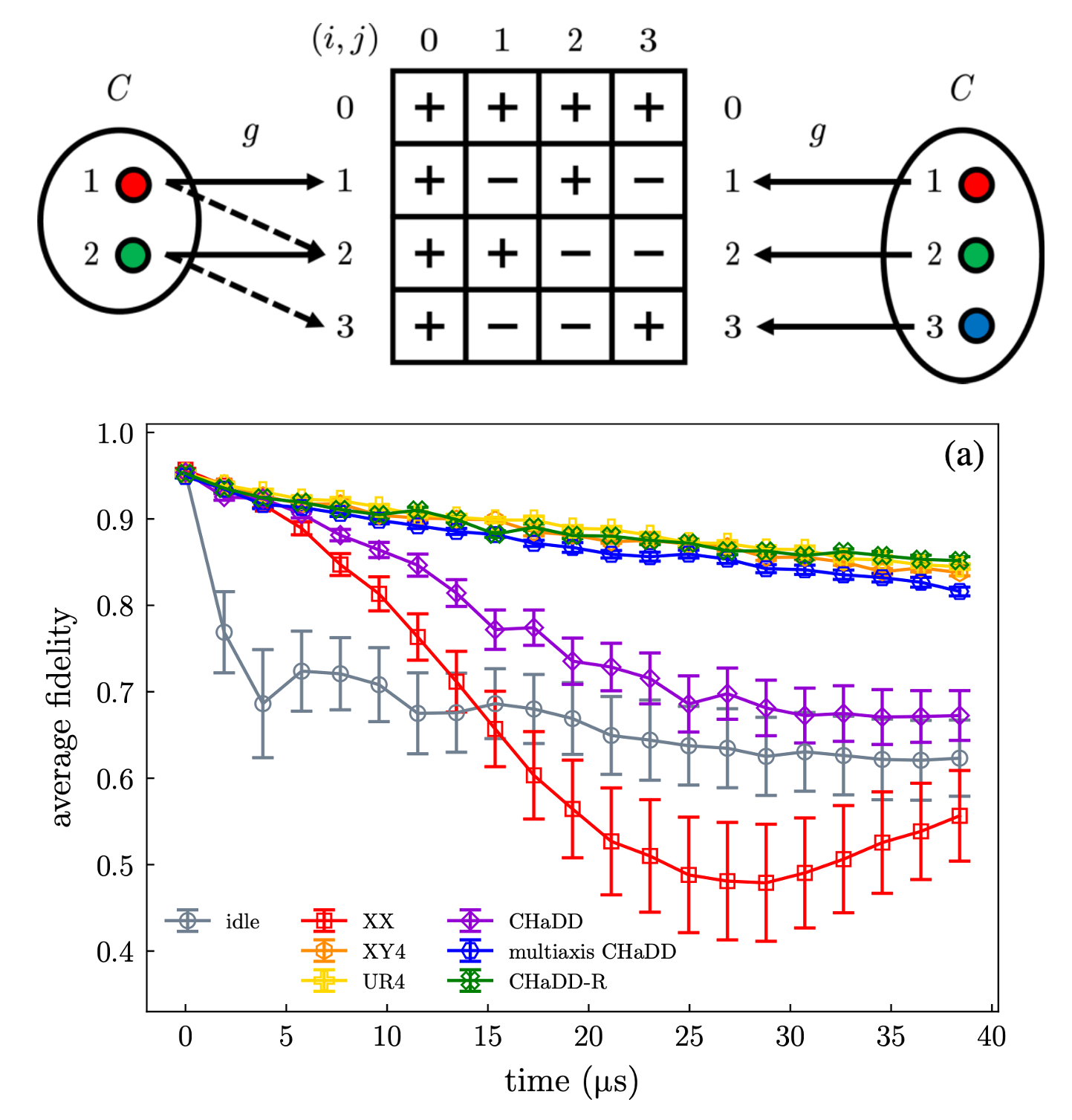
USC researchers have developed Chromatic-Hadamard Dynamical Decoupling (CHaDD), a method to suppress environmental decoherence and inter-qubit crosstalk in large-scale processors. By applying graph-theoretical coloring and Hadamard-derived pulse sequences, CHaDD neutralizes noise while maintaining constant circuit depth, regardless of the total qubit count. Unlike conventional dynamical decoupling methods that often scale poorly as the number of qubits increases, CHaDD provides an exponential improvement in scaling for large-scale arrays by maintaining a constant circuit depth and a 20–33% lower pulse repetition rate.
Benefits
- Reduced Depth: for general interactions, the circuit depth scales quadratically with the chromatic number; for the common case of ZZ crosstalk, it scales linearly
- Independence from Qubit Count: in hardware with fixed connectivity, the time required to suppress errors does not increase even if you double or triple the number of qubits
- Experimentally Validated: demonstrated on IBM QPUs
Key References
Brown, Amy F., and Daniel A. Lidar. "Efficient Chromatic-Number-Based Multiqubit Decoherence and Crosstalk Suppression." PRX Quantum 6.2 (2025): 020354. https://doi.org/10.1103/1d4l-73x6