Description:
Background
Many advanced materials and molecular systems require precise, reversible control over molecular interactions. Applications for responsive materials, biomedical systems and adaptive surfaces need on-demand, localized, and reversible control of binding interactions. There is a clear need for small molecule platforms that can be controlled with benign inputs while offering predictable, tunable interaction capabilities such as hydrogen bonding.
Technology Description
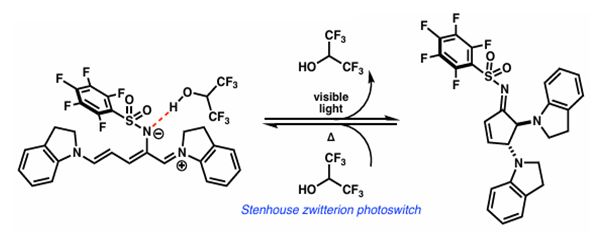
USC researchers have developed a new class of zwitterionic Stenhouse photoswitches that enable light-controlled, reversible noncovalent interactions with high precision. These compounds function as molecular “on/off switches” for hydrogen bonding, with key advantages that directly translate to real-world usability. This platform provides a modular, light-controlled way to regulate molecular interactions, making it easy to integrate into materials, surfaces, or chemical systems.
Benefits
- High switching efficiency (~96%) with rapid thermal recovery on minute timescales (~4 minutes).
- Strong optical response in the visible range, tunable absorbance up to ~649 nm.
- <7% fatigue across 5 switching cycles.
- Scalable and modular synthesis suitable for material and chemical system integration.
Stage of Development
Fully characterized photoswitches
Applications
- Smart polymers and adaptive materials
- Photoresponsive coatings and surface functionalization
Related Publication:
ChemRxiv 2026, DOI: 10.26434/chemrxiv.15000976/v1