Description:
Abstract
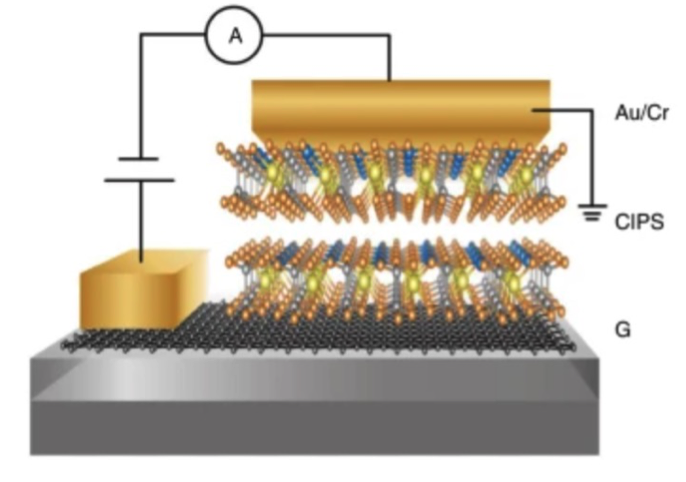
USC inventors have developed a ferroelectric tunnel junction with improved barrier height modulation ability and ultrahigh TER. The device uses layered copper indium thiophosphate as the ferroelectric barrier and graphene and chromium as asymmetric contacts. The ferroelectric field effect of these materials can induce a barrier height modulation of 1 eV in the junction, ten times that of previous devices, which results in a TER of above 10^7.
Benefit
- Significantly improved barrier height modulation and tunneling electroresistance
- Low power consumption
Market Application
In ferroelectric tunnel junctions, a thin ferroelectric layer acts as a tunneling barrier with an adjustable height determined by ferroelectric polarization. They offer low power consumption, non- volatile switching, and non-destructive readout, positioning them as a promising technology for memory and computing applications. However, typical junctions are limited by small barrier height modulation, and achieving a high tunnelling electroresistance (TER) remains challenging.
Publications
High tunnelling electroresistance in a ferroelectric van der Waals heterojunction via giant barrier height modulation, Wu et al., 2020.
Stage of Development
- Prototype developed
- Tested
- Available for licensing
Applications