Description:
- Biomedical research
- Aerospace engineering
Abstract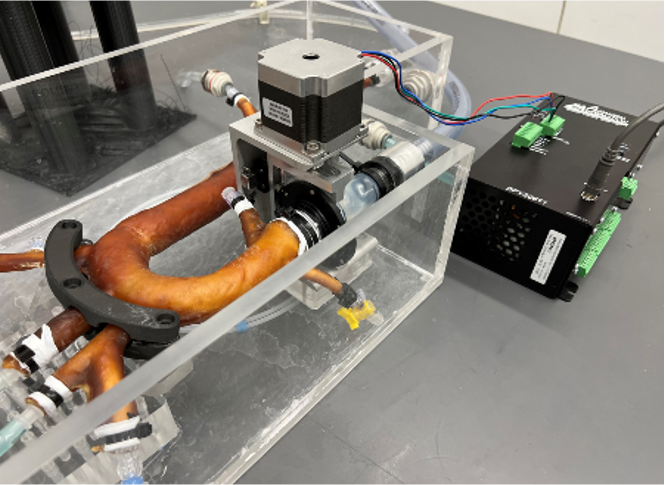
USC researchers have developed a longitudinal impedance pump. Utilizing an excitation system that stretches the elastic walls of a fluid-filled tube, the device initiates a pumping mechanism with wave propagations and reflections. The excitation mechanism comprises an active stretch and passive recoil, and the pump can be regulated via stretching frequency, length of the active stretch, characteristics of the elastic material, and locations of the reflection sites.
Benefit
- Employs longitudinal stretching of a fluid-filled medium
- Excitation mechanism includes active stretch and passive recoil
- Pump can be controlled via multiple mechanisms
Market Application
In valveless pumping systems, the pumping components and fluid do not touch, and devices achieve pumping through impedance mismatch and wave motion in compliant tubes. These devices are highly valuable in the biomedical and aerospace industries. Impedance-based devices generate waves via asymmetric tube compression, and the non-linear flow dependency on excitation frequency in these pumps creates a unique driving mechanism. However, the low mean flow rates of these devices offer limited use for real flow improvement applications. Aortic stretch/recoil wave pumping inspires a new generation of longitudinal impedance pumps that can generate considerable net flow. Leveraging these different techniques presents a promising opportunity for developing improved valveless pumping devices.
Publications
Aghilinejad A, et al. On the longitudinal wave pumping in fluid-filled compliant tubes. Phys. Fluids (2023).
Other
Stage of Development
- Functioning prototype developed