Description:
Background
Electron sources used in free-electron lasers, advanced microscopy, and next-generation particle accelerators suffer a trade-off between brightness, efficiency, operational lifetimes, and average current. The current systems give strong emission and improved electron multiplication, but they do not meet operational standards. A more robust system should support efficient amplification, stable vacuum emission, and scalable integration into practical electron source systems.
Technology Description
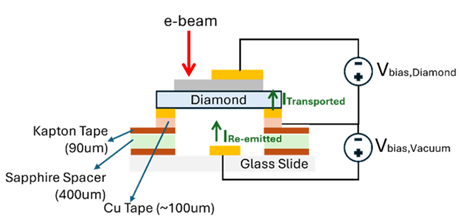
USC researchers have developed a technology that uses an electronic-grade single crystal diamond amplifier with defect densities below 1 ppb as the gain medium, hydrogen terminated negative electron affinity surface, and a conductive graphene overlayer. The graphene encapsulation improves charge compensation and suppresses the DC shielding effect, giving more stable operation and enhanced re-emission performance. The platform demonstrated solid-state electron amplification >8000x at the emission surface, ~120x vacuum re-emission gain, and >150x re-emission amplification in the graphene encapsulated structure.
Benefits
- Improved beam brightness and quantum efficiency.
- Better charge compensation and reduced DC shielding with graphene encapsulation.
- Longer operational lifetime and more reliable performance than conventional cathodes.
- Scalable architecture suited to both continuous and pulsed operation.
Stage of Development
- Lab prototype
- Pending US provisional patent application
Applications
- Particle accelerators
- Advanced electron microscopy