Description:
Background
Natural cellular signaling networks decode dynamic input features such as frequency to produce precise, context-dependent responses, whereas most existing synthetic and optogenetic systems are limited to binary on/off control. This inability to interpret dynamic input states fundamentally constrains the precise and tunable regulation of complex cellular behaviors for advanced research and therapeutic applications. Thus, frequency-modulated optogenetic platforms are needed to safely and reversibly control engineered cell therapies, including CAR-T cells, with external precision.
Innovation
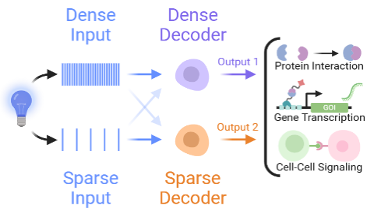
USC researchers have developed an optogenetic system that enables frequency-modulated control of cellular functions in mammalian cells by decoding dynamic blue light pulse frequencies into distinct intracellular responses. It comprises with two main modules: a dense decoder, which uses a fast-reverting photosensitive protein that responds to high-frequency light inputs, and a sparse decoder, which combines fast-reverting and slow-reverting components that responds to low-frequency light. These computationally designed and optimized modules can independently or multiplexedly regulate protein interactions, gene transcription, and cell-cell communication, allowing for precise control over processes like antigen presentation for CAR-T cell targeting or paracrine signaling for cell differentiation.
Advantages
- Improved the safety and efficacy of engineered therapeutic cells through precise and externally tunable frequency-modulated light
- Expanded the information bandwidth of optogenetic interfaces with a single-wavelength frequency-multiplex control
- Demonstrated applicability to regulate protein interactions, gene transcription, and cell-cell communication
Stages of Development
- Tested in vitro with human immortalized leukemia cell line
- Tested in vivo with leukemia xenograft mouse models