Description:
Background
Cancer stem-like cells (CSLCs) are a primary driver of tumor relapse, metastasis, and resistance to immunotherapy, particularly in solid tumors. Mechanical softness within the tumor microenvironment promotes immune evasion, yet current CAR-T strategies lack effective approaches to identify and eliminate these mechanically resistant cell populations.
Innovation
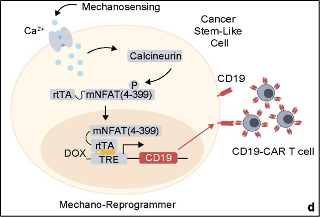
USC researchers have developed a first-in-class genetic “Mechano-Recorder” that converts cancer cells’ mechanical experiences into stable genetic signals. This platform uses ultrasound stimulation induced-soft tumor environments to capture calcium signaling and barcodes mechanically resistant cancer stem-like cells for identification and targeting. The system can then be rewired into a “Mechano-Reprogrammer,” driving expression of a clinically validated CAR-T antigen (i.e. CD19) specifically in these resistant cells. This converts mechano-stemness into a programmable “kill me” signal, enabling CAR-T cells to eliminate previously untargetable solid tumor stem-like populations in vitro and in vivo.
Advantages
• Exposed hidden resistant cells by genetically labeling cancer stem-like populations driven by soft tumor microenvironments.
• Converted resistance into vulnerability by inducing synthetic CAR-T target antigens directly in immune-evasive cells.
• Enhanced solid tumor CAR-T efficacy through combination targeting of bulk tumor cells and rewired stem-like subpopulations.
• Enabled modular customization to express alternative therapeutic antigens beyond CD19 for multiple tumor types.
Stages of Development
• Tested in vitro with patient-derived breast cancer cells and multiple cancer cell lines
• Tested in vivo with murine breast cancer models
Publications
https://www.nature.com/articles/s41563-025-02391-8